
From tulips to high-tech: spotting investment bubbles vs. golden opportunities
Mar 24, 2026

In a market dominated by AI hype and rising gold prices, you’d be wise to wonder if we’re witnessing an exciting moment of genuine growth (with all the opportunities that brings), or the beginnings of an investment bubble or two.
Understanding the difference is vital, if you want to protect your capital.
To get you up to speed, we’ll explore how bubbles build and burst, the drivers behind them, and what smart investors look out for. From tulips and trains to cutting-edge tech, we’ll also take a few lessons from history to help you navigate your next steps in investment.
What is a financial bubble, and how does it form?
An investment bubble (also known as a financial, asset or stock market bubble) forms when the price of an asset quickly rises above its genuine, real-world value. The speed at which the price goes up is usually driven by excited investors buying in speculatively. In other words, to turn a quick profit.
There’s usually some media hype around the asset, meaning a lot of people join the race to invest, hoping that prices will stay on an upward trajectory. But, in the case of a bubble, what goes up, must come down.
What makes a bubble burst?
Once a market peaks, those in the know tend to get out quick. With confidence in the asset undermined, others quickly follow suit. And, in the rush to sell, prices plummet. In other words, the bubble bursts.
How can you spot an investment bubble?

Spotting a bubble while you’re in the thick of it is notoriously hard to do. When a shiny new asset enters the market (think dot-com companies or further back, the railways), there’s always a rush to invest.
In hindsight, what might seem like the obvious signs of a bubble can, in the moment, look a lot like a sound investment. After all, both online companies and train operators eventually became an essential part of everyday life. So investors at the time can be forgiven for thinking they had nothing to lose.
When considering whether a bubble is building, it’s worth looking at a few key points:
1. Prices
Are prices rising faster than real-world earnings? If valuations are shooting up without much underlying evidence of success, it might be time to pause.
2. Hype
Is there a sudden frenzy around the asset, with people racing to get on board? If there’s a belief that prices can only go up, you might want to ask a few questions.
3. Risk
Are investors borrowing to buy the asset? While putting more money into the mix can amplify gains, the same will apply to losses.
4. Buzz
Is the asset getting a lot of media coverage and cropping up in conversation – online and in person? In the past, bubbles have often been cultural talking points.
5. FOMO
Are friends and family with little or no investment experience getting involved? When there’s a rush to buy in from people less in the know, it can signal the late stages of a bubble.
Tulips, trains and tech – a short history of investment bubble

Hindsight’s a wonderful thing. And it can teach us a lot about economics. So let’s take a look back through some of history’s most famous asset bubbles.
Tulip mania
In 17th-century Holland, anyone who was anyone had a thing for tulips. Much like designer handbags or fast cars today, Amsterdam’s wealthiest set took to collecting and planting rare varieties to show off to their friends.
Gardens were lovingly designed and planted to displayshow off their collections, and prices rose until bulbs were worth astonishing sums of money. As prices soared, speculators were priced out, at which point the market abruptly collapsed.
The race for the railways
Skip forward two centuries and across the North Sea, and you’d be hard pressed not to be excited by the advent of the British railway network. With the launch of the first intercity line linking Manchester and Liverpool in 1830, hopes were high for this new age of fast, convenient transport.
With the technology proven, small private companies began to appear, each planning their own stretches of track. Of course, funding would be required, and who better to supply it than the Great British public? Demand for more cross-country connections was high and the money came flooding in. What could possibly go wrong?
But, by 1845, it became clear that optimism outstripped reality in many of the plans, and there was far too much overlap in the routes. Prices plummeted and fortunes were lost.
The dot-com boom
Next, fast forward to the mid-1990s. The internet was in its infancy, but its enormous potential was clear. Investors quickly jumped in, and stock prices for online companies began to rise – regardless of their actual viability or earnings.
Seeing the opportunity to make some easy money, more people followed suit, pushing prices higher and spreading the word further still.
Call it FOMO or following the herd, but logical thinking quickly went out the window, with many buying in without doing their due diligence. So up went the prices again.
Once the market peaked, expert investors jumped ship, leaving prices in freefall. Confidence shattered, the bubble had burst. Start-ups collapsed, and trillions of dollars of investment capital vanished overnight.
Is there an AI bubble in the making?
Identifying a bubble as it happens is easier said than done, so there’s no simple yes or no answer to this. There are certainly parallels with the dot-com boom though, which is making some investors urge caution.
While artificial intelligence has the potential to transform everything from healthcare and manufacturing to software and finance, the key word is potential. AI companies are attracting huge amounts of investment and media hype, not to mention ambitious valuations, in what is still a relatively unproven arena.
And, as we know, when a gap between valuations and underlying fundamentals opens, it should raise questions – and perhaps a few red flags.
New technologies will always cause a stir in the markets. But whether this period of intense speculation is an overvaluation or a real, long-term opportunity remains to be seen.
Is gold in a bubble?
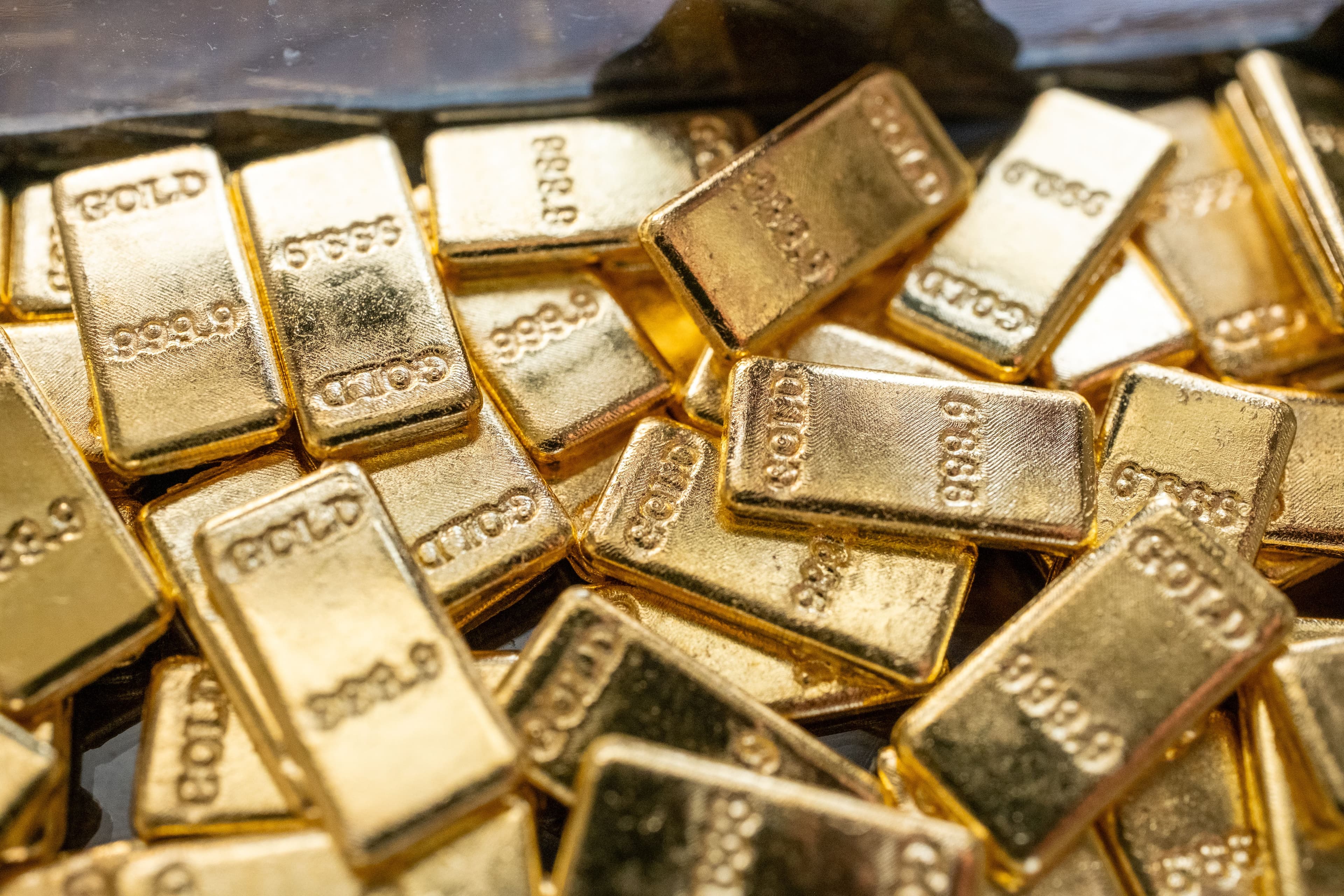
Where does gold fit into the picture? Is it perched among the tulips, as a fad investment, bound to burst? Or is buying gold bars and gold coins a relatively safe bet in an unstable world?
Unlike many assets driven primarily by short-term speculation, gold tends to respond to broader macroeconomic conditions such as inflation expectations, real interest rates, currency movements, and geopolitical risk. Recent developments in the Middle East, particularly the escalation of tensions involving Iran, have reinforced just how sensitive gold can be to shifting market dynamics. Rather than moving in a straight line, prices (quite unusually) have traded in quite a wide range - at times fluctuating between roughly $5,000 and $5,400 per ounce in short periods - highlighting the role of both safe-haven demand and macro pressures such as a stronger dollar or changing rate expectations.
Gold therefore does experience periods of volatility and correction. However, these moves are typically linked to evolving economic conditions rather than purely speculative excess. While prices may rise or fall in response to changing expectations, the underlying drivers tend to be structural, which distinguishes gold from assets more commonly associated with bubble dynamics.
Luckily, thanks to live gold price charts, it’s easy to pick your moment to invest. Just remember that past performance isn't indicative of future results.
Take a lesson from the past
Like it or not, history shows that asset bubbles are part of the financial landscape. From tulips and trains to high-tech stock, familiar patterns appear again and again: excitement, rapid growth and a boom fuelled by speculation, then an abrupt bust as the market corrects itself.
In today’s markets, shaped by AI innovation and rising gold prices, it’s worth looking to the past as you invest in your future. But asking whether something looks like a bubble isn’t the same as predicting one. It’s a sensible place to start though, if you plan to make informed decisions before you invest.