
Could AI and data centres become a new driver of silver demand?
From chatbots to image generators, self-driving cars to scientific research, AI is transforming a huge range of industries, and at pace.
But with this change comes growing demand for incredibly powerful computing infrastructure.
With the news that Meta have invested more than $50 billion in one data centre alone, and five tech companies have collectively committed over $1 trillion in future leases connected to data centres, the big names in AI are setting up for some serious expansion.
But will all the extra servers, power systems and networking equipment lead to increased demand for silver? After all, silver is essential to many of the components involved.
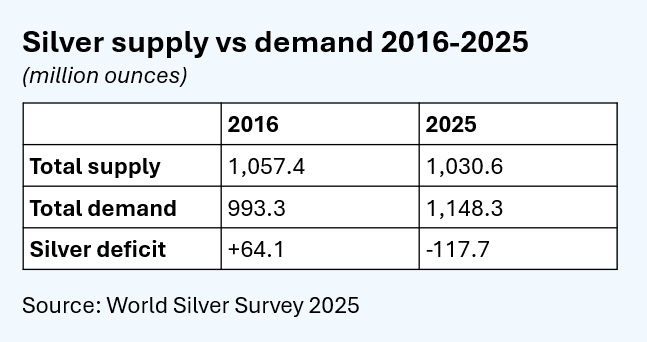
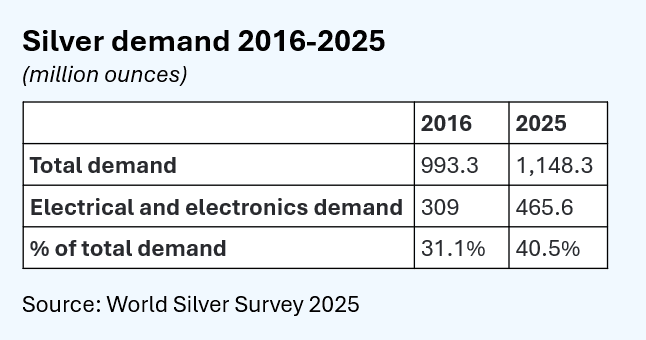
According to the World Silver Survey 2025, electrical and electronics accounted for 465.6 million ounces of silver demand that year. That’s around 41% of the total global demand.
Total supply was forecast to be 1030.6 million ounces for 2025, while demand stood at 1148.3 million ounces, meaning silver is already in deficit.
So what could the growth of AI mean for long-term industrial silver demand?
Why silver is essential in modern technology
Silver has the highest electrical conductivity of any metal, making it the first choice for things like circuit boards, electrical contacts, connectors and switches.
Add to this its excellent thermal conductivity, corrosion resistance and long-term reliability and it’s all but unbeatable in electronic applications, from the phone in your pocket to solar panels and medical equipment.
Although individual devices only contain a tiny amount of silver, scale this over billions of products worldwide and demand quickly adds up.
Where silver is used in AI infrastructure
While AI itself doesn’t consume silver as such, the hardware behind it certainly does.
Modern AI workloads use vast numbers of high-performance servers filled with processors, memory modules and complex circuit boards. And many of these components rely on silver in electrical contacts, connectors and other conductive elements to keep everything running smoothly.
As well as the servers, data centres need sophisticated networking systems and of course an enormous amount of electricity. Every circuit breaker, switch and router in the building will contain a small amount of silver.
So is AI really increasing silver demand?
At this stage it’s hard to tell. While the creation of new data centres gives a fair indication that AI might be driving more demand for silver, reports like the Silver Institute's World Silver Survey still group AI-related electronics within the broader electrical and electronics sector.
Until we can attribute specific amounts to AI use, we can’t reliably track it as a distinct category. What’s clear though is that demand for silver in electronics is growing.
AI is only one part of the bigger picture
While AI as an industry is often in the headlines, it’s important to remember that it’s just one part of the industrial silver picture.
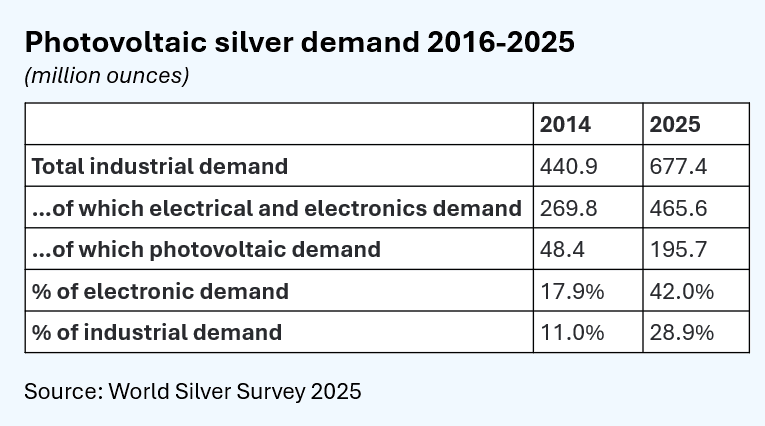
In fact, in recent years, solar energy has been leading the charge in industrial silver demand
According to the Silver Institute, in 2014, only 11% of industrial demand came from solar photovoltaics. That figure had reached nearly 29% in 2025.
Another important contributor to industrial silver demand is the burgeoning electric vehicle sector.
According to the Silver Institute, EVs need, on average, 67-79% more silver than a conventional car, to support battery management systems, power electronics, charging infrastructure, and electrical contacts.
Thus, they expect EVs to overtake internal combustion engine vehicles as the primary source of automotive silver demand as soon as 2027.
The final piece of the industrial silver demand puzzle comes from consumer electronics, telecoms and medical devices, all of which depend on silver’s unique blend of conductivity and reliability.
And so, against this varied backdrop, AI should still be seen as an emerging addition to existing demand, with its full impact yet to be felt.
What could this mean for silver investors?
For investors, AI represents an interesting long-term trend rather than a guaranteed driver of higher silver prices.
If demand for data centres, advanced semiconductors and the associated electrical equipment continues to grow, silver consumption may gradually increase alongside it.
At the same time, silver prices depend on far more than industrial demand. Investment flows, mine production, recycling rates, interest rates, inflation, global economic conditions and broader market sentiment all play important roles in determining prices.
💡 What affects the price of silver?
Manufacturers are also working to reduce material costs by improving efficiency and, where possible, substituting alternative materials. These trends could offset some of the additional demand created by AI infrastructure.
The bottom line
Artificial intelligence and the rapid construction of data centres is increasing demand for advanced electronic equipment. And, since silver is essential to the efficiency of many of these components, AI is likely contributing to industrial silver demand, even if indirectly.
However, current evidence suggests AI is still a relatively small part of the overall silver demand picture. Solar energy, electric vehicles and other electronics are more significant sources of industrial consumption today.
As AI adoption accelerates, its influence on silver demand may become more noticeable – and more traceable.
For now though, it’s probably best viewed as a complement to silver's already diverse range of industrial applications. Let’s watch this space, and keep an eye on the live price.
Ready to get started? Read our beginner’s guide to silver

The Spotlight
The free newsletter helping you understand how to build your wealth.