The silver deficit: a quick guide for investors
In recent years, demand for silver has exceeded supply, thanks largely to growing sectors like electric vehicles, solar power and semiconductors linked to AI.
But is there a connection between a deficit and the price of silver? And what are the implications for investors? Let’s take a look.
🔎At a glance
Since 2021, demand for silver has exceeded supply. This deficit has been accompanied by rising silver prices.
Our calculations show that there is indeed a positive correlation between deficit and price. If the deficit increases, the price of silver also increases.
However, the correlation is actually quite weak, meaning other factors have a far greater influence on the price of silver.
What causes a silver deficit?
Before we dive into the data, and explore the link between supply, demand and prices in the silver market, let’s clear up what exactly the deficit is.
In short, when demand for silver exceeds supply, a deficit occurs. Whether it’s being used for industrial purposes, turned into jewellery or bought in physical form as an investment, more silver is required than has entered the market that year.
So where does the supply come from?
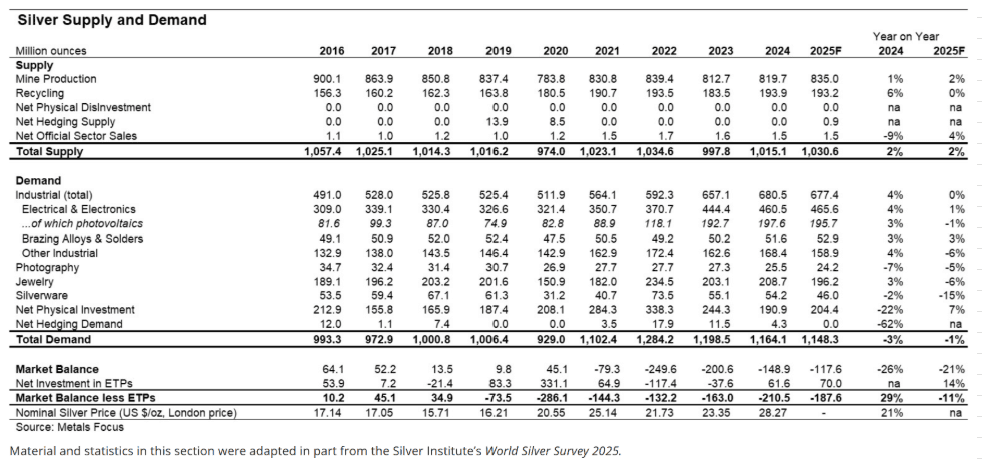
- Silver mining: Since 2016, an average of 837 million ounces of silver have been mined annually. New silver production accounts for approximately 82% of the supply. Since silver is generally a by-product of mining other raw materials, production can’t simply be ramped up to keep pace with demand. This is what’s called an ‘inflexible supply’.
- Recycling: Since 2016, an average of 178 million ounces of recycled silver have been placed on the market. This corresponds to approximately 17% of the total supply. Recycled silver is recovered, for example, from electronic devices.
Overall, demand for silver has significantly exceeded supply in recent years. In 2025, the market deficit is forecast at 117.6 million ounces.
How does the deficit affect the price of silver?
We know that silver supply and demand are closely linked. So it makes sense that if demand outstrips supply, prices rise.
But is it really this clear cut?
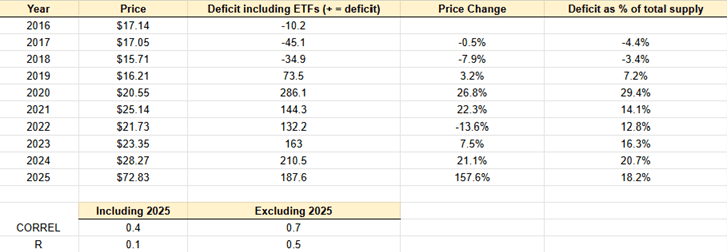
To answer this question, let’s look at the official data from the Silver Institute and compare the development of the deficit with the price of silver. This method, also known as correlation analysis, shows the relationship between two variables.
- ±1: If the correlation value is ±1, there is a perfect relationship between the variables. If variable X increases/decreases by 1 unit, variable Y also increases/decreases by 1 unit.
- 0: If the correlation value is 0, there is no relationship between the variables, meaning they move independently of each other.
- R-squared (R): This indicates how well a statistical model fits the real data. A value of 0 indicates that the model is unusable. A value of 1 indicates that the model fits the data perfectly.
A look at the actual data shows that the silver deficit does indeed have an impact on rising silver prices – but significantly less than is often reported:
- From 2016 to 2025: The correlation was approximately 0.38, while R was approximately 0.14. Over this period, there was therefore a rather weak relationship between the increasing deficit and rising silver prices. This was mainly due to 2025, when the price was strongly decoupled from the deficit.
- From 2016 to 2024: If we exclude the 2025 data, we see a correlation of 0.72 and an R-value of 0.51. So there was a significantly stronger relationship between deficit and price development up until 2024.
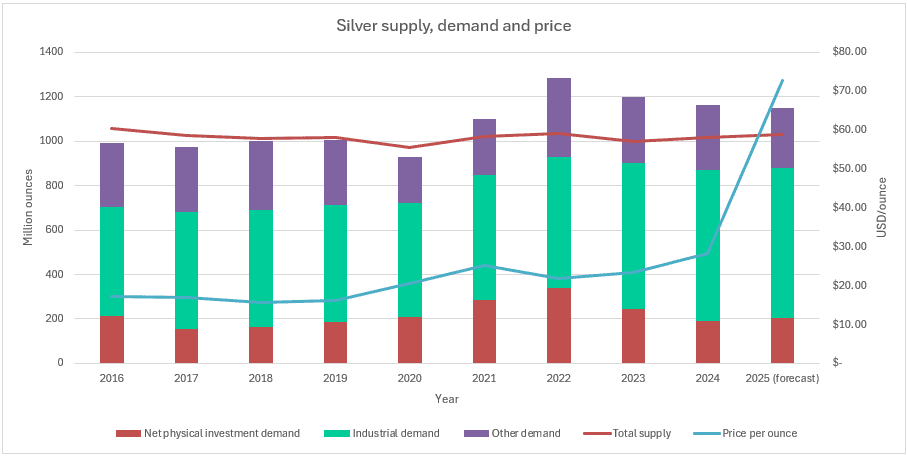
The figures show that while physical deficits create fundamental price pressure, macroeconomic events (monetary policy, inflation spikes, currency devaluation) cause prices to skyrocket – as happened in 2025.
What other factors influence the price of silver?
Our analysis shows that the silver deficit is actually quite a weak indicator for the development of the silver price. Other factors appear to play a much larger role:
Monetary and macroeconomic factors
- The US dollar exchange rate: Since silver is primarily traded internationally in US dollars, there is generally an inverse correlation. A weaker US dollar makes silver cheaper for international buyers, increasing demand and ultimately the price.
- Real interest rates: Silver itself does not generate interest or dividends. If real interest rates rise, interest-bearing investments (such as government bonds) become more attractive, which puts downward pressure on the price of silver.
- Inflation: In times of high inflation or persistent currency weakness, investors seek protection in tangible assets, which can increase investment demand for silver.
- Gold-silver ratio: Historically, silver has often moved in the same direction as gold. The gold-silver ratio serves as a valuation metric for investors to identify periods of over- or undervaluation.
Economic factors
Unlike gold, silver is largely dependent on industrial demand.
- Industrial production: During periods of strong economic growth, the demand for silver increases. Conversely, a global recession can dampen industrial silver demand.
- Emerging technologies: Growing industries such as photovoltaics, AI and electric vehicles are significantly increasing industrial silver demand.
- Geopolitical crises: Wars, trade conflicts or banking crises increase the demand for ‘safe haven’ assets like precious metals, which can drive up the price of silver.
Summary
For years, demand for silver has exceeded global supply, but this physical market deficit alone doesn’t fully explain the price of silver.
Statistically, the deficit creates the fundamental basis for higher prices, but it only represents one part of the picture.
The actual impetus for strong price jumps comes from macroeconomic drivers such as a weak US dollar, falling interest rates, inflation, and geopolitical crises.
In addition, enormous growth in emerging industries such as solar, AI and electric vehicles is driving up demand.
At GOLD AVENUE we offer a wide selection of high-quality silver products, along with a live price tracker to keep you up to speed on the value of your silver investment.