
Gold Price Forecasts for 2026: Towards a New Historic Plateau?
After a record-breaking rally, can gold’s momentum carry into 2026? We break down the key forces ahead.
- The year 2025 will undoubtedly go down in the annals of the precious metals market as an exceptional vintage. After breaking through multiple highs and surpassing the symbolic threshold of $4,000 per ounce for the first time, gold firmly established itself in 2025 as an essential component of diversified portfolios, having evolved from a simple inflation hedge into what many institutions now describe as a strategic reserve asset.
As we turn toward 2026, the question is no longer whether gold has entered a higher pricing regime, but how durable this new level may prove to be. Against a backdrop of persistent geopolitical tensions, uncertain U.S. fiscal policy, shifting interest-rate expectations and sustained central-bank demand, major financial institutions are reassessing their outlooks for the year ahead.
2025 in Review: The Year of Records
Gold experienced a spectacular rise over the past 12 months, delivering gains of +70% by the year end. This historic rally unfolded in several defining phases:
A cascade of new records
The yellow metal broke decisively above $3,000 per ounce in the spring, accelerated toward $4,000 during the summer, and reached new all-time highs above $4,500 in the final quarter of the year. According to the World Gold Council, 2025 saw more than 50 separate record closes, underscoring the breadth of the move.
The drivers of the rally
- Central-bank demand remained the dominant structural force, particularly from emerging markets seeking to diversify reserves away from the U.S. dollar.
- Monetary policy expectations shifted as investors priced in an eventual easing cycle from the U.S. Federal Reserve, reducing the opportunity cost of holding non-yielding assets like gold.
- Geopolitical risk and trade uncertainty, including tariff threats and regional conflicts, sustained a persistent risk premium.
The return of Western investors
After several years of subdued interest, flows into gold ETFs turned positive again in 2025. This re-engagement from institutional and retail investors amplified price momentum and reinforced gold’s role as portfolio insurance rather than a tactical trade.
2026 Forecasts: What Do the Financial Giants Think?

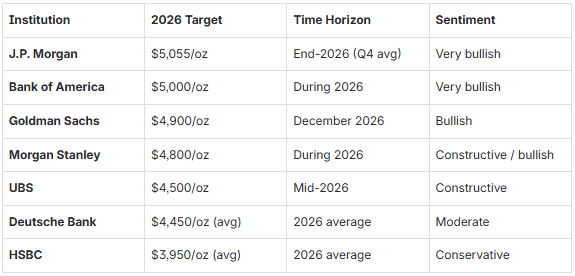
Major investment banks have revised their gold price forecasts materially higher for 2026. While the consensus remains constructive, price targets vary depending on assumptions around growth, inflation, rates and official-sector demand.
Expert commentary
“While it remains difficult to determine precisely when the catalysts and capital flows that will push prices higher will materialise, we remain deeply convinced that gold demand will be powerful enough to continue driving prices toward $5,000 an ounce in 2026.”
Gregory Shearer, Head of Metals Strategy, J.P. Morgan
Why Such Differences Between Forecasts?
Rather than offering a single point forecast, the World Gold Council emphasises that 2026 outcomes depend on the broader macroeconomic regime. Its framework outlines four defining scenarios:
The “Doom Loop” Scenario (+15% to +30%)
A deep global slowdown combined with escalating geopolitical tensions would trigger a flight to safety. In this environment, gold could reach new historic highs, potentially above $5,300/oz.
The “Shallow Slip” Scenario (+5% to +15%)
Economic growth slows but avoids recession, prompting faster-than-expected rate cuts from the Federal Reserve. A weaker dollar, lower real yields and rising risk aversion create a supportive backdrop for gold.
The Macro Consensus Scenario (-5% to +5%)
Growth remains stable and rate cuts are already priced in. Gold consolidates its 2025 gains, trading sideways at elevated levels without a strong directional trend.
The Return of Reflation (-5% to -20%)
Stronger-than-expected U.S. growth and persistent inflation keep yields high and the dollar firm. Risk appetite shifts back toward equities, triggering a correction in gold prices.
The Four Macroeconomic Forces Supporting Gold in 2026
To understand why institutional views range from cautious to strongly bullish, it helps to examine four core dynamics shaping the gold market.
1. ETF Demand and the Structural Strength of Central Banks
This remains the most widely cited bullish factor.
- Central banks: Since 2022, reserve diversification has accelerated. Goldman Sachs estimates that every additional 100 tonnes of net central-bank purchases can lift gold prices by roughly 1.7%.
- ETFs: Despite 2025’s rally, gold still accounts for only ~2.8% of global assets under management, compared with 4–5% during previous bull cycles. Even modest re-allocation could have an outsized price impact.
2. Opportunity Cost: Real Rates and the Fed’s Path
Gold’s attractiveness is closely tied to returns available elsewhere.
- Bullish case: Most banks expect rate cuts from the Fed, BoE, and ECB in 2026, lowering real yields and reducing the opportunity cost of holding gold.
- Downside risk: Deutsche Bank highlights stickier inflation and fewer-than-expected rate cuts as the primary risk to gold prices.
3. Fiscal Deterioration and “Explosive Debt”
This is a key theme for Bank of America.
- Debasement risk: With U.S. federal debt exceeding $36 trillion and deficits widening, gold is increasingly viewed as a hedge against long-term currency erosion.
- Confidence risk: In an era of unconventional fiscal policy, gold is seen not just as an inflation hedge, but as protection against sovereign balance-sheet stress.
4. Geopolitics and Policy Uncertainty
Gold remains a global barometer of financial anxiety.
- Stagflation risk: Weak growth, persistent inflation and trade tensions support bullish scenarios such as the WGC’s “Doom Loop”.
- Reflation risk: A clear policy success that strengthens growth and the dollar could temporarily cap or reverse gains.
Conclusion: A New Pricing Regime
For 2026, most analysts agree on one crucial point: gold’s floor has moved structurally higher. Levels once considered peaks now appear closer to long-term support, and prices around $4,000 per ounce may increasingly be viewed as a baseline rather than an extreme.
Whether gold ultimately reaches $5,000 per ounce or consolidates after its historic run, it continues to confirm its evolving role, not merely as a tactical hedge, but as a core reference asset within diversified portfolios and long-term wealth strategies.