
US midterm elections 2026: How the gold price could change?
On 3 November 2026, Americans vote for a new Congress. For gold investors, the result matters, but so does how closely it matches what the markets are expecting.
Markets look ahead, responding to changing expectations before laws pass or conflicts end.
That makes the 2026 US midterm elections relevant to anyone with a pension or investment portfolio, including those who hold gold or other precious metals. A change in Congress could reshape expectations for trade, tariffs, government spending and the wars in Iran and Ukraine. Expectations about future US policy can influence the dollar, interest rates and demand for gold before any changes take effect.
But there is no straightforward link between a party winning and gold rising.
What do the US midterms decide?
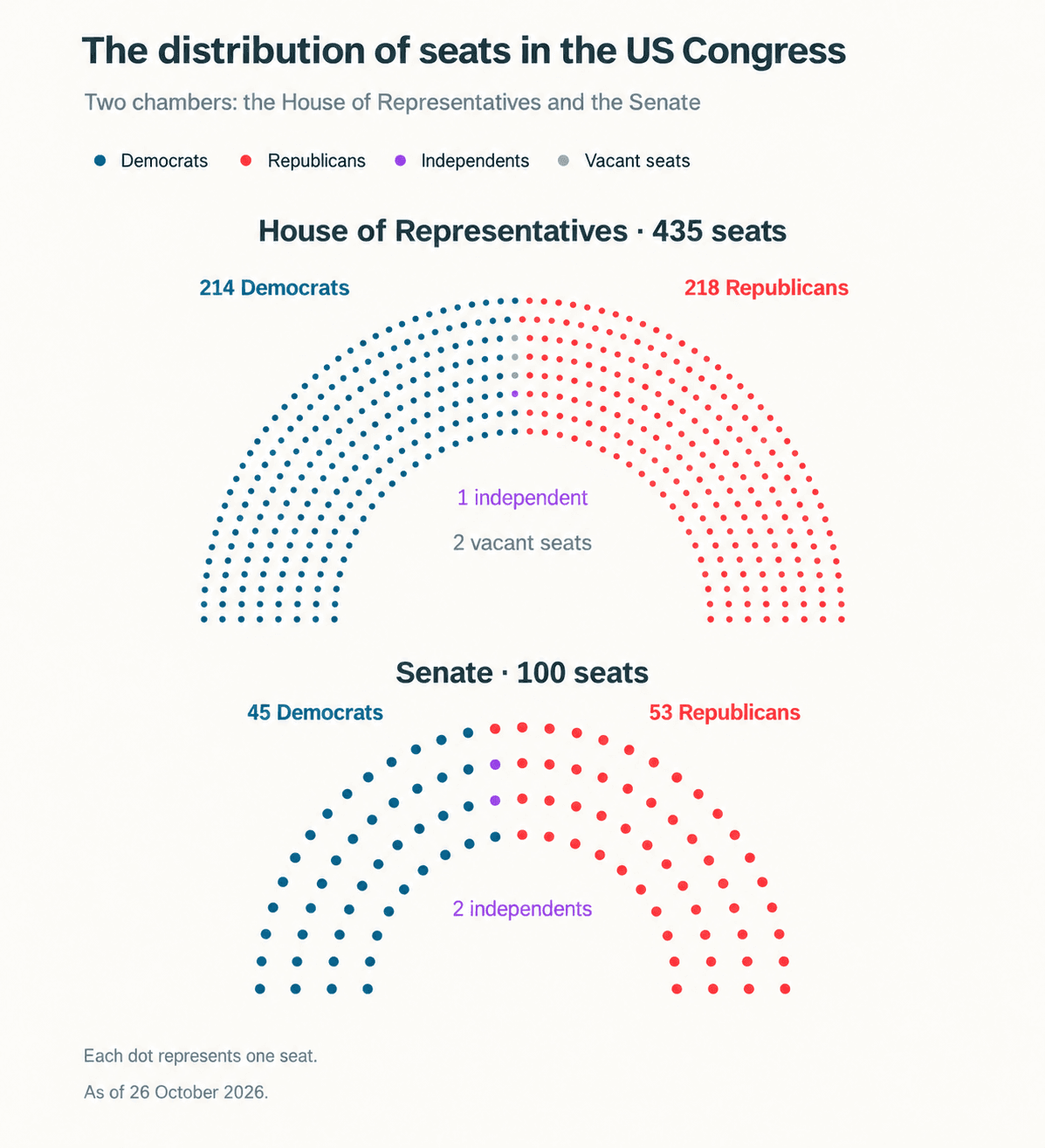
The midterms take place halfway through a president’s four-year term. On 3 November, all 435 House seats and 35 Senate seats are being contested. Together, the two chambers form Congress, which passes legislation and approves federal spending. Donald Trump, of the Republican party, remains president whatever the result.
Republicans currently control both the House and Senate. Losing either would make passing legislation harder; losing the Senate would also give Democrats control over whether to confirm presidential nominees. The new congressional terms begin on 3 January 2027.
What are prediction markets expecting?
Prediction markets currently favour Democrats taking control of both chambers. On 26 October, Polymarket’s combined Congress market put the probability at approximately 66%. A Democratic House with a Republican Senate stood at around 27%, while Republicans retaining both chambers was about 8%. A Democratic Senate with a Republican House was below 1%. Rounded prices need not total exactly 100%.
Polymarket lets participants trade contracts on real-world outcomes. A contract priced at 66 cents pays $1 if the event happens and nothing if it doesn’t. Its price is interpreted as roughly a 66% probability.
These trading prices reflect expectations, liquidity and the participants involved. They can change quickly, and also be wrong.
Is a Democratic victory already priced in?
An anticipated outcome may have less impact than a surprise. If investors already expect Democrats to win, confirmation might prompt a smaller reaction than Republicans unexpectedly retaining control.
But prediction-market odds can’t tell us how fully gold or currency markets reflect that possibility. Investors must also judge what a new Congress could achieve. Expecting resistance to tariffs is different from expecting tariffs to disappear.
What can past elections tell us about gold?
Previous elections offer no reliable rule for predicting gold’s direction. The World Gold Council’s analysis of US presidential elections found no statistically significant relationship between the winning party and gold’s performance around the vote. Its findings concern presidential elections, rather than midterms, but underline the difficulty of drawing conclusions from party labels alone.
Interest rates, currencies and geopolitical developments also influence prices during election periods. A rise or fall after polling day therefore doesn’t establish that the result caused it. A more helpful question for investors is what the election changes about expectations for policy and economic conditions.
How do elections affect gold?

Four connections help explain how political expectations reach the gold market.
Uncertainty. Concern about conflict, policy changes, or disputed results can encourage demand for protection. Gold’s safe-haven role doesn’t prevent price falls. Conversely, credible progress towards stability can reduce demand.
Interest rates. When bonds offer higher yields after allowing for inflation, holding gold carries a greater opportunity cost. Falling real yields can make it more attractive.
The dollar. A stronger dollar makes dollar-priced gold more expensive for buyers using other currencies, potentially dampening demand. For existing European holdings, however, it can increase gold’s euro value.
Public finances. Tax and spending plans affect expectations for growth, inflation and borrowing. Concerns about debt can encourage demand for gold, while higher real bond yields can work in the opposite direction.
UK and European investors should therefore follow the gold price in pounds or euros alongside the dollar benchmark. For illustration, a 10% dollar-price increase combined with a 5% fall in the dollar’s pound value produces a gain of approximately 4.5% in pounds, before costs. Our year-end review of gold in different currencies explores how exchange rates affect returns.
Trump and the gold price: what could Congress change?

Tariffs, energy prices and military commitments connect the political debate to inflation, growth and investor confidence. A new congressional majority could change the pressure on the administration without immediately changing these policies.
Tariffs: Congress has constitutional authority over trade but has delegated substantial tariff powers to presidents. It could legislate to restrict those powers; existing tariffs wouldn’t automatically expire after an election.
Ukraine: A Democratic Congress could advance assistance and scrutinise its delivery. Substantial Republican support would strengthen its ability to overcome presidential opposition.
Iran: Congress could seek restrictions on funding and continued hostilities. That could increase pressure for negotiations, but Congress can’t guarantee a settlement acceptable to the US, Iran and other parties. Reuters examines these potential foreign-policy changes here.
The central limitation is Trump’s veto: overriding it requires two-thirds of those voting in each chamber, with a quorum present. Most contested ordinary legislation also needs 60 Senate votes to end debate, under current rules. A narrow majority provides leverage, not unrestricted power.
Three outcomes: what could they mean for gold?
The following are conditional scenarios, as opposed to price forecasts. Each could affect confidence, the dollar and interest-rate expectations in different ways.
Republicans retain both chambers (least likely outome)
Trump would retain a more favourable route for legislation, although agreement within his party would still hold plenty of weight. Investors would assess the scale and financing of further tax and spending measures.
Greater policy continuity could reduce some uncertainty. Expectations of higher inflation or borrowing could support demand for protection, while stronger growth, higher real yields or a firmer dollar could weigh on dollar-priced gold.
Because prediction markets currently assign this outcome a relatively low probability, confirmation could require a larger reassessment of expectations.
Each party controls one chamber
A split Congress would require more compromise over legislation and spending. Investors might welcome limits on major policy changes, while watching for prolonged budget disputes.
Constraints on additional spending could ease some borrowing concerns. Repeated confrontations, however, could increase uncertainty and demand for protection. Expectations for growth and interest rates would influence which effect mattered most for gold.
The implications would also depend on which party controlled the Senate, given its role in confirming presidential nominees. Meanwhile, the president would retain significant executive and diplomatic powers.
Democrats take both chambers (most likely outcome)
Democrats would gain greater ability to block legislation, investigate the administration and negotiate over spending. European allies might see scope for renewed cooperation on trade and Ukraine, although policy changes would remain uncertain.
If investors anticipated less trade friction or progress towards de-escalation, demand for safe-haven assets could ease. Alternatively, confrontation between Congress and the White House could increase political uncertainty. Any accompanying dollar weakness or fall in real yields could support gold.
Could uncertainty continue after election day?
Even if Democrats win both chambers, they would not take control until 3 of January 2027. During those two months, Trump and the outgoing Republican-controlled Congress could seek to advance legislation, appointments or other priorities. Existing legal limits would still apply, but investors could face accelerated policy activity rather than immediate restraint.
The result itself could also take time to settle. Disputes over district boundaries, ballot eligibility, postal voting or certification could lead to recounts and court challenges in closely contested races. Legal disputes are already under way, including an administration lawsuit seeking to prevent certification of Alaska’s Senate result if the Republican incumbent narrowly loses. Such challenges do not, by themselves, establish electoral wrongdoing.
The question for markets would be whether these disputes could change control of Congress or materially delay clarity about the outcome. Prolonged uncertainty could encourage demand for gold as protection, although movements in the dollar and real interest rates could reinforce or offset that response.
What moves gold beyond US politics?
Central banks pursue reserve strategies that extend beyond US elections. The World Gold Council reported net central-bank purchases of 39 tonnes in August 2026, reflecting reported buying minus selling rather than a complete estimate of all activity.
Inflation data, central-bank decisions and geopolitical developments also continue independently of the vote.
What does this mean for long-term gold holders?
The helpful question is how gold fits your finances, rather than which party might help its price next week. Consider your existing allocation, when you might need the money, and purchase premiums, selling spreads and storage costs.
If regular purchases already suit your plan, spreading them over time reduces dependence on one day’s price. It doesn’t guarantee a profit or a lower average cost.
With GOLD AVENUE’s Auto-Invest, you can automate purchases of selected precious metals at your chosen frequency and adjust or pause your plan.
The midterms are important because they can change expectations. For long-term decisions, watch what follows: the policies agreed, the conflicts resolved or prolonged and the response of interest rates and currencies.

The Spotlight
The free newsletter helping you understand how to build your wealth.