
Why are European countries moving their gold, and what could it mean for investors?

It has been widely reported across the business news media, that several European central banks are moving some of their gold reserves. The question is, why?
Between March and August 2026, De Nederlandsche Bank (DNB) reallocated approximately 86 tonnes of Dutch gold from New York and Ottawa to London. It said the change would make its reserves easier to trade and leave the Netherlands “better prepared for severe crises” amid increasing geopolitical uncertainty.
France has also removed its remaining gold from New York, while Germany transferred substantial quantities to Frankfurt during the 2010s. These moves have prompted speculation about Europe’s relationship with the United States, but central banks are balancing several concerns: security, accessibility, liquidity, and geographic risk.
What has happened to Europe’s gold?
The Netherlands holds around 612 tonnes of gold. The latest reallocation increased the proportion held in London from 18.1% to 32.1%. Around 30.8% remains in the Netherlands, while New York and Ottawa each hold approximately 18.5%.
However, not all 86 tonnes physically travelled across the Atlantic. Around 59 tonnes were sold in New York and replaced with equivalent gold bought in London. More than 27 tonnes were physically moved from North America to the Netherlands, while a similar quantity already held there was transferred to London.
This is therefore a reallocation rather than a straightforward repatriation. The Netherlands still owns the same amount of gold; it is simply held in different places.
London was chosen because it is one of the world’s largest physical gold markets. Bullion held at the Bank of England must meet internationally recognised trading standards, making it easier to sell or exchange quickly.
“With this relocation, we have improved the tradability of our gold reserves,” said DNB president Olaf Sleijpen. “We expect that we will never need to use them, but we do need to strengthen our resilience and preparedness.”
Between July 2025 and January 2026, the Banque de France sold its remaining 129 tonnes of older gold in New York and bought an equivalent quantity of newer, market-standard bars in Europe. France’s total reserves were unchanged.
Germany completed a major redistribution in 2017 and now holds just over half its gold domestically, although substantial reserves remain in New York and London. Italy also stores a significant share of its gold in New York. Some politicians have called for it to be returned, but Banca d’Italia has announced no such move.
This is part of a wider trend. In the World Gold Council’s 2026 Central Bank Gold Reserves Survey, 9% of respondents said they had increased domestic storage during the previous year, while 10% had diversified their overseas storage locations, up from 2% a year earlier.
Why was European gold stored abroad?
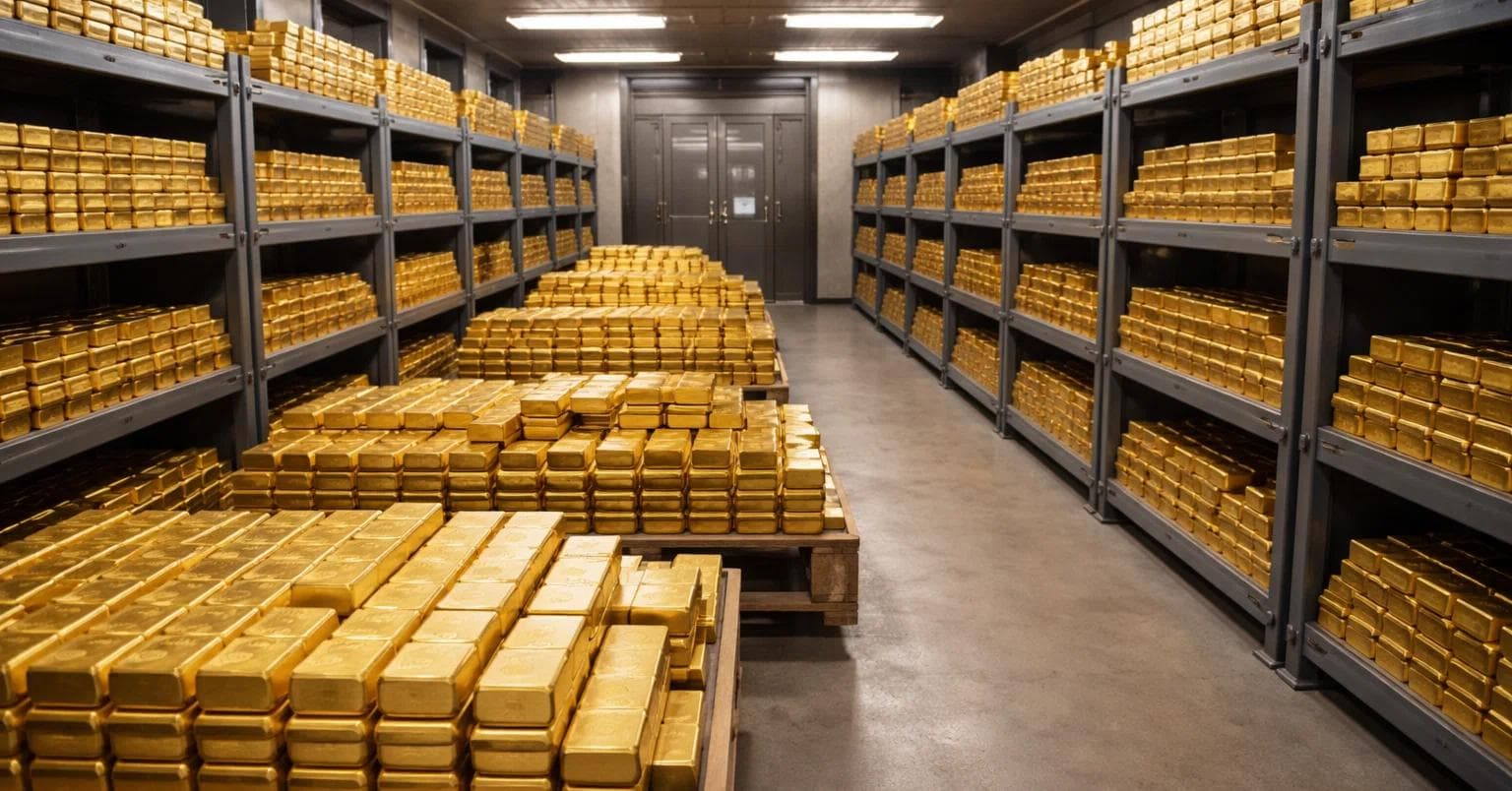
There are sound historical and practical reasons for keeping gold in international financial centres.
During and after the Second World War, some European countries moved reserves abroad to protect them from conflict. New York’s security and importance to the post-war monetary system made it a logical choice. London also became a leading physical gold market, allowing bullion to be traded without moving heavy bars between countries.
The Federal Reserve Bank of New York, for example, stores gold for governments, central banks, and international organisations. It acts as custodian: the gold does not belong to the Federal Reserve.
Domestic storage also requires secure vaults, specialist staff, auditing, and insurance. Overseas storage can therefore be practical. The latest changes simply show that the balance between security, cost, access, and liquidity is being reassessed.
Why are central banks reconsidering storage now?
Wars, trade disputes, sanctions, and changing international relationships have highlighted the possibility that governments could lose access to assets held in other jurisdictions.
The immobilisation of Russian central-bank assets has sharpened awareness of that risk. This does not mean European gold in the US is about to be frozen or seized, but it explains why reserve managers consider unlikely scenarios.
Crisis preparedness is another factor. Gold can act as an asset of last resort, but its usefulness partly depends on how quickly it can be sold, exchanged, or used as collateral.
This explains why the Netherlands chose London rather than bringing everything home. DNB wanted bullion close to a large market where it could be traded quickly. No single location offers every advantage.
Does this mean Europe no longer trusts the US?
There isn’t enough evidence to support that conclusion.
Some politicians have argued that national gold should be brought home, but these views should be separated from the central banks’ official explanations.
DNB referred to geopolitical unrest, crisis preparedness, and tradability. France presented its operation as a technical modernisation. Germany has retained substantial holdings in New York, whose security and legal protection the Bundesbank continues to defend.
The evidence points to a reassessment of risk, not a wholesale withdrawal of confidence in the United States.
What can individual gold investors learn?
Private investors operate on a very different scale from central banks, so their decisions should not be treated as a blueprint for individual investors. But they do highlight some practical questions worth considering when buying and storing physical gold.
What exactly are you buying?
Gold exposure can take different forms, from financial products linked to the gold price to physical bars and coins. If you choose physical gold, it is worth understanding how your products are held and what the provider's storage model means for you.
At GOLD AVENUE, every physical precious metals product purchased through the platform belongs to the customer and is held outside GOLD AVENUE's balance sheet. Learn more about our storage solution.
Where and how is your gold stored?
Location is only one part of the equation. Security, insurance, auditing, the storage provider and the conditions under which your precious metals are held are also important considerations. Investors should understand how their chosen provider stores and protects their products.
Can you access your gold when you need to?
Physical gold may be highly liquid globally, but investors should also consider how their individual holdings can be accessed. This includes how easily they can sell, any applicable fees or spreads, and whether they have the option to take physical delivery.
Will moving European gold affect its price?
Reallocating existing reserves does not automatically create new demand.
If a central bank sells gold in New York and buys the same amount in London, its total holding remains unchanged. The transactions may affect local market flows, but they do not represent additional worldwide demand.
The story may still matter as a signal. Central banks have bought around 1,000 tonnes of gold annually on average over the past four years, twice the preceding decade’s average. Their focus on accessibility reinforces gold’s role as a strategic reserve asset.
However, gold prices are influenced by many forces, including interest rates, inflation, currencies, investment demand, central-bank buying, and geopolitical risk. Moving existing bullion between vaults is not, by itself, a reason to expect the price to rise.
Gold ownership is also about access
“I don’t get a sense that there’s an impending doom,” Joseph Cavatoni of the World Gold Council told the BBC. Instead, these movements suggest that central banks are thinking more carefully about how their gold is managed.
For individual investors, the considerations are different. But the same story highlights some of the practical aspects of holding physical gold, including where it is stored, how it is protected, and the options available to sell or take delivery.
The recent moves by European central banks reinforce gold’s role as a strategic reserve asset while also highlighting the importance of how it is held and managed. Location, security, liquidity and access are all part of that picture.