
Why has the price of gold been falling?
When it comes to investing in gold, you’ve no doubt heard the term ‘safe haven asset’. Sounds reassuring. Sounds, well, safe.
Combined with a decades-long upward trend in prices, gold has long been an attractive prospect for both casual investors and those looking to diversify a large portfolio.
But the last six months have been rather rocky for gold.
So what’s going on? Are we seeing a short-term dip as the market corrects, or is there a longer-term trend in play? Let’s take a look.
The gold price drop 2026 – how it unfolded
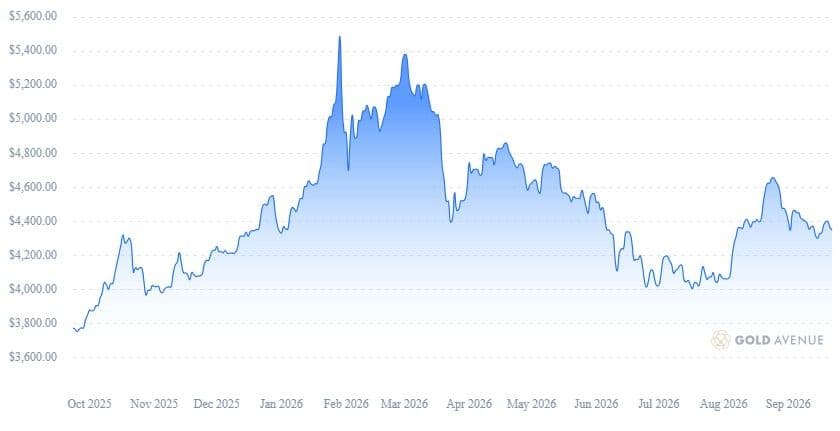
Back in late January, gold hit an all-time high of around $5,594/oz. This followed a steep climb starting in August 2025, when prices were hovering around the $3,300/oz mark.
By early August 2026 though, gold had retreated to around $4,000/oz – a 25-28% fall in the space of six months.
While it’s rallied in the last month or so, and has remained above last autumn’s price, there’s still a fair bit of volatility in the market.
What drove the fall?
There’s never one simple answer to a question like this, and a combination of factors is at play here – some economic, some geopolitical – many of which are interconnected themselves.
1. A more hawkish Federal Reserve
While new Fed Chair Kevin Warsh played his cards close to his chest and kept investors guessing early on, interest rates were hiked to 3.75%-4.00% in mid-September.
This means that investors can get better returns from other investments. Suddenly, holding gold – which earns no interest or dividend income – becomes less attractive.
Then, the forces of supply and demand come into play, as sellers drop prices to appeal to a smaller pool of buyers.
2. A stronger US dollar
After starting 2026 at a four-year low, the dollar has made something of a comeback in recent months, thanks to higher interest rates, stronger Treasury yields and rising oil prices.
Since gold is priced in USD, there’s usually an inverse relationship between the two. When the dollar goes up, gold becomes more expensive for foreign investors, impacting demand and so prices.
3. Profit-taking and ETF outflows
After a rally, it’s understandable that investors might choose to lock in some gains with a spot of profit-taking.
Whether they’ve invested in physical gold or ETF shares, the sudden flurry of sales sends gold back into the market, where prices then drop. Supply and demand at play once again.
4. Geopolitics
While political unrest typically sees more investors turning to gold, and prices increasing as a result, that hasn’t played out amid this year’s US-Iran conflict.
Instead, rising oil prices (hello again, supply and demand) have led to renewed inflation fears. This in turn has made it more likely that central banks will hold or raise interest rates – again, making other investment options more appealing than gold.
👀 Further reading
What the latest central bank decisions mean for investors and gold ️
Cyclical correction or sign of a collapse?
While investors might be feeling jittery, it’s important to look at the longer term when it comes to assets like gold.
Year on year, gold is up 15.2% - from $3,774/oz on 23 September 2025, to $4,348 on 22 September 2026.
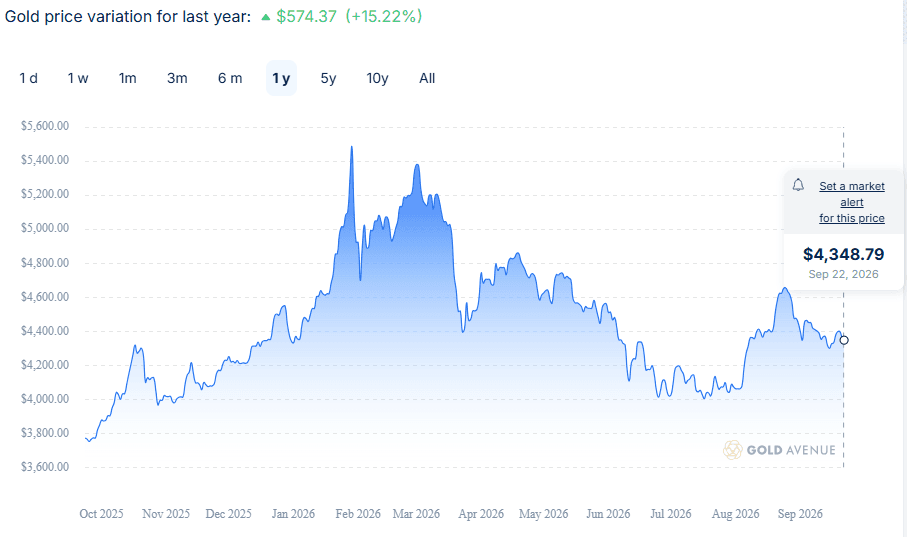
Overall, the trend is still tracking upwards, suggesting this dip is a cyclical gold correction driven mainly by interest-rate expectations.
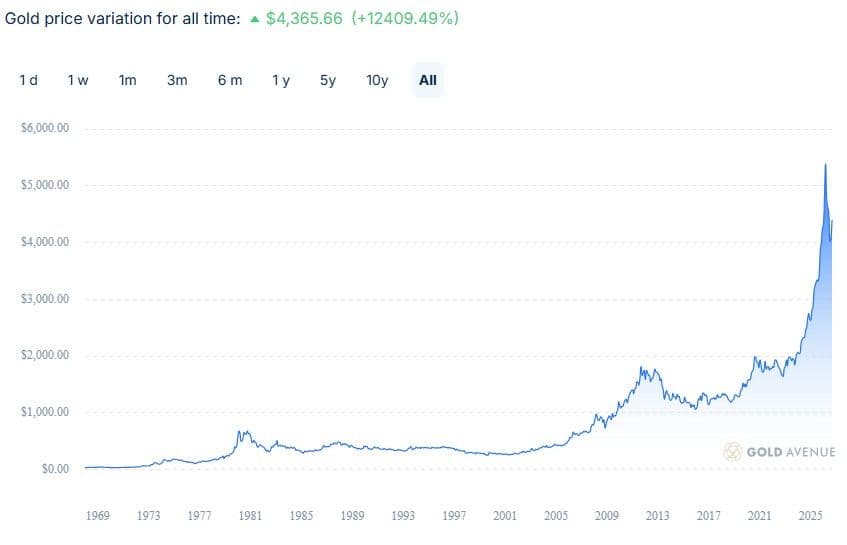
It’s not the first time it’s happened, either.
Historic dips in gold
- 1970s – Between 1971 and the start of 1980, gold prices soared from around $35/oz to $850/oz. It was by no means plain sailing though. Along the way there were multiple gold corrections in the region of 20%, and a pullback of near 45% between 1975 and 1976. Of course prices recovered and went on to hit new highs.
- 2008 – Amid the global financial crisis, gold dropped from around $1,000/oz to roughly $700/oz – a 30% decline in the space of eight months. Once central banks stepped in with stimulus measures though, gold recovered and went on to hit a then-record high in 2011.
- 2020 – When Covid hit, it took just 10 days for gold to fall 10-12%, from $1,680/oz on 9 March to under $1,500/oz on 19 March. Prices quickly stabilised though, and climbed to a then-record of $2,060/oz by August.
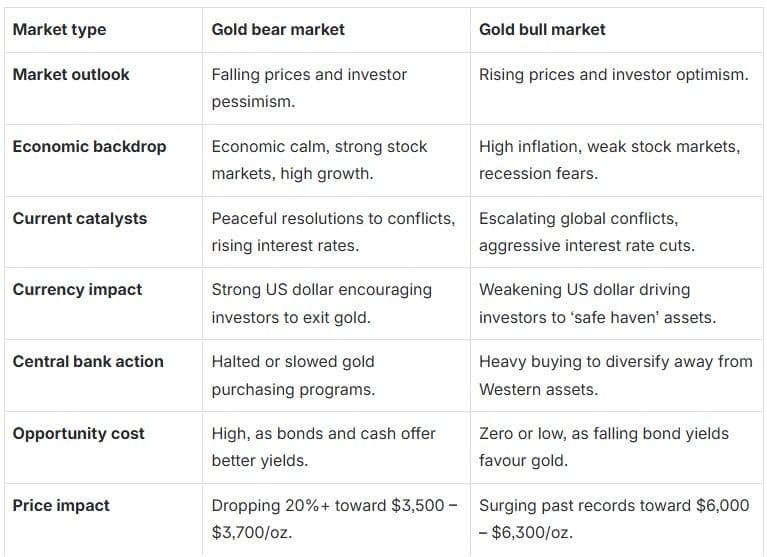
Bear vs. bull
So will gold continue to recover in 2026? And is now a good time to buy gold? It all depends on whether recent movement is the start of a bear-like downturn or a small blip in a longer-term bull market.
Here’s how each scenario could play out.
Should I buy gold now?
Whenever prices drop, it’s natural to wonder, ‘is now a good time to buy gold?’ If you’re deciding whether to buy the dip, it’s the same calculated risk as always. It will likely come down to gold vs. interest rates and which looks like giving the better return.
Will gold continue to recover in 2026? There’s no way of knowing, and it all depends on your investment aims and timeframes. If you’re in it for the long haul, you might have a different approach to someone looking to make a quick buck.
A good place to start your research though is by tracking the live price of gold, and even setting a market alert.
You can also get up to speed on previous market movements with our articles Gold year in review 2025: and Gold price forecast for 2026.
And when you’re ready to invest, explore our range of gold coins.
– – – – – – – – – – – – –
Past performance is not a reliable indicator of future results. This article is for informational and educational purposes only and does not constitute financial, tax, or investment advice. The value of precious metals can fluctuate in both directions. Price data cited is accurate as of 23 September 2026.