Gold and oil prices: is there a connection?
Following the outbreak of the Iran war and the closure of the Strait of Hormuz, oil prices have skyrocketed. Driven by high energy prices, inflation has also risen sharply, showing that oil is, quite literally, the fuel of the global economy. But what does this mean for the price of gold?
Summary (as of 21 April 2026):
- Since 1987, both the price of gold and oil have risen. However, the price of oil has been subject to strong fluctuations, while the price of gold has remained relatively stable.
- The Iran war, triggered US airstrikes back in late February, has driven the price of crude oil up significantly. At one point, the price of a barrel of Brent crude rose by almost 100%.
- There is generally little to no correlation between the price of crude oil and gold. In fact, oil price movements are generally a poor indicator of shifts in the price of gold.
- Over the past five years, the price of gold and oil have often moved in opposite directions.
- The current gold-to-oil ratio is approximately 38. This means that one ounce of gold is equivalent to 38 barrels of Brent crude (approximately 6,042 litres).
Two oil varieties dominate the world market
Brent and WTI are two types of crude oil that play a crucial role in global market price development. Brent is the benchmark for more than half of the world market, while other oil grades are traded at a premium or discount to the Brent price, depending on their characteristics.
WTI – a lower density, light crude oil – is the price benchmark for the US. Brent and WTI prices are generally close, but can vary slightly.
Brent is traded on the London/ICE Futures Europe exchange, while WTI is traded on the New York Mercantile Exchange (NYMEX). Both Brent and WTI are traded in US dollars.
The Iran war, which began on 28 February, has had a massive impact on oil prices. The main cause of price increases has been the closure of the Strait of Hormuz – one of the most important international crude oil shipping routes. Since the start of the war, the price per barrel has risen by almost 100% at times.
The historical price development of crude oil and gold
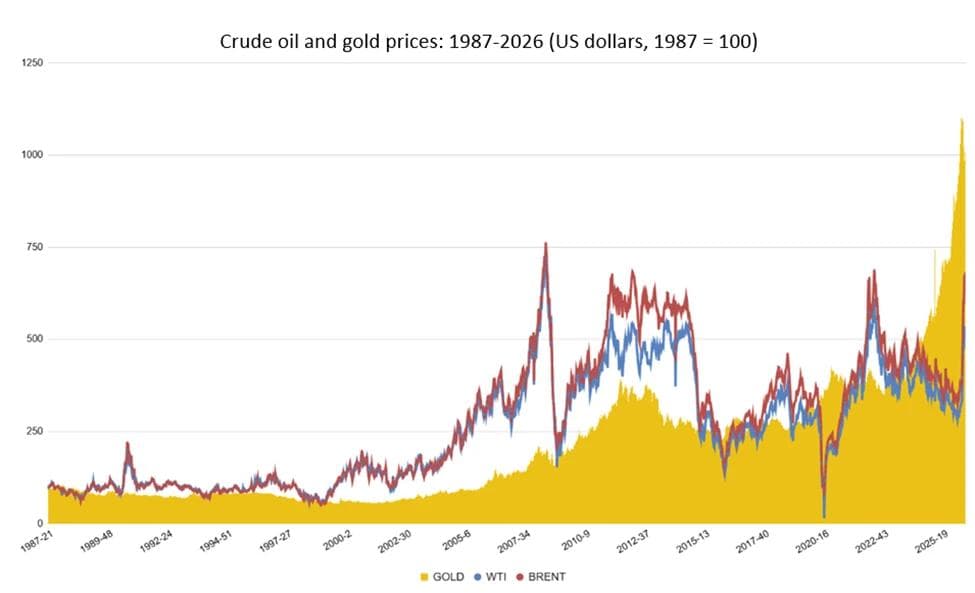
While a barrel cost around $62 at the beginning of January, investors had to pay up to $124 in mid-April.
While this is certainly an extreme and sudden price increase, it's worth noting that crude oil is a very volatile commodity overall:
- During the financial crisis of 2008-9, the price of crude oil crashed by 78.5%.
- At the beginning of the Covid pandemic, crude oil went into freefall, but recovered during 2022, achieving price gains of up to 622%.
The nominal return on crude oil since 1987 has been approximately 565%. By comparison, the nominal return on gold in the same period has been 904%, since it’s generally subject to fewer price fluctuations.
How much crude oil can you buy with one ounce of gold (gold-oil ratio)?
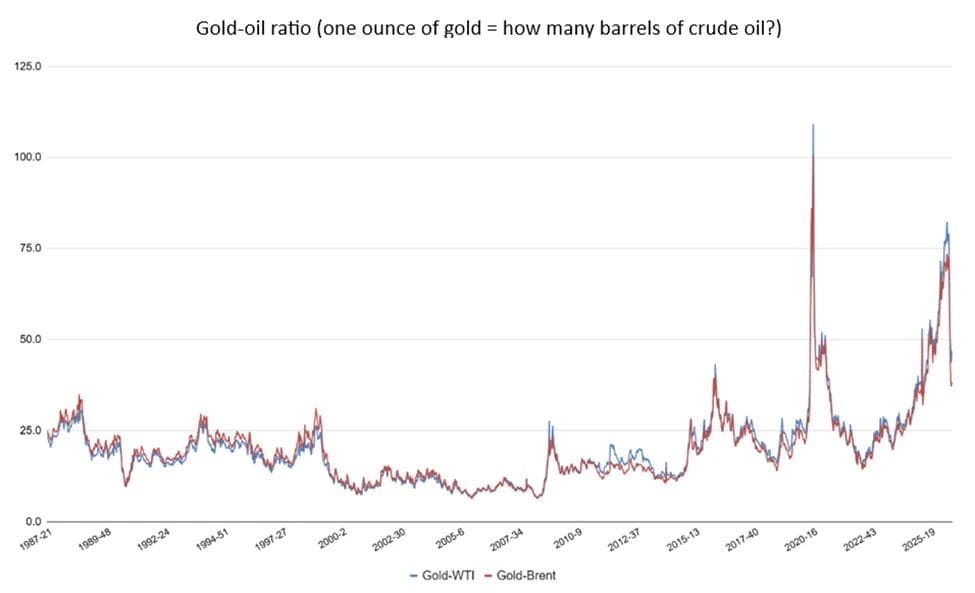
One metric popular with investors is the so-called gold-oil ratio. This indicates how many barrels of crude oil are equivalent to the value of one ounce of gold.
Currently, this ratio is approximately 38 for Brent and 47 for WTI. Investors could therefore buy up to 47 barrels of crude oil with one ounce of gold.
The historical average for the gold-oil ratio is around 20 (for WTI and Brent). Currently, the ratio is significantly higher, which some investors interpret as a sign of a relatively high gold price level.
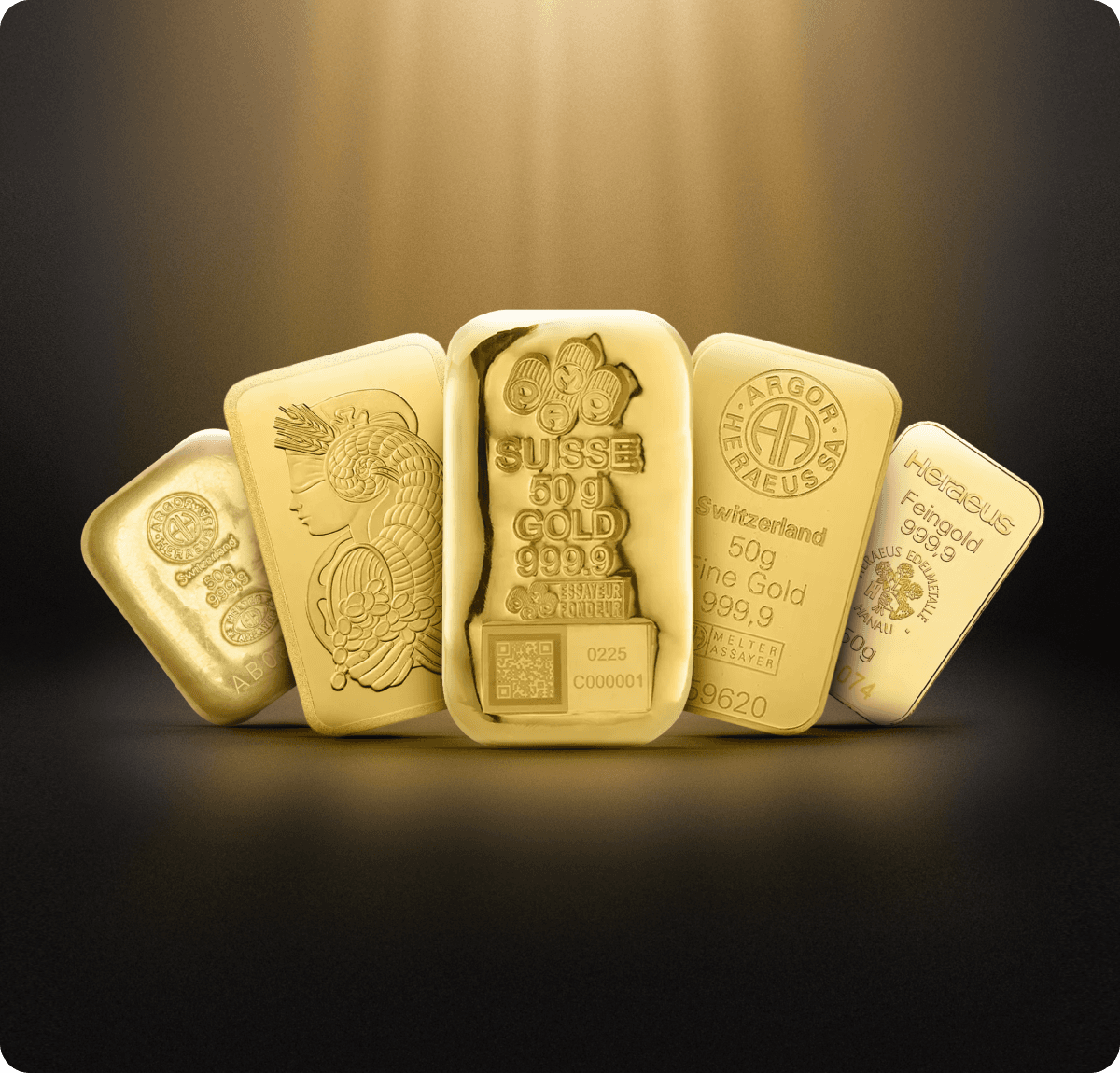
goldbars
Is there a connection between the price of gold and the price of oil?
Many investors believe that the price of gold and the price of crude oil are related and that the price of one can be used as an indicator of the price development of the other.
At first glance, this seems to make sense, as gold and oil do have some similarities:
- Gold and oil are naturally limited resources that cannot be arbitrarily increased, and their extraction incurs costs.
- Due to their scarcity and the extraction costs, both gold and oil have intrinsic value.
- Gold and oil have increased in value over a long period.
However, if you look at the actual price movements, there's not much evidence of any "interaction" between the two commodities.
The correlation matrix of gold and oil
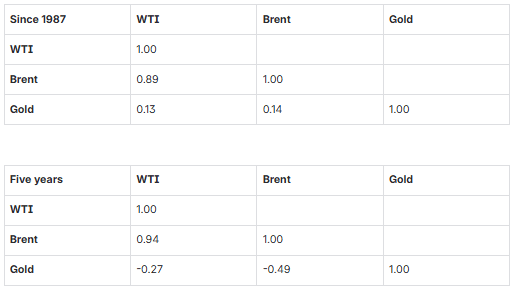
Economists use a scale from -1 to +1 to describe the relationship or correlation between price movements:
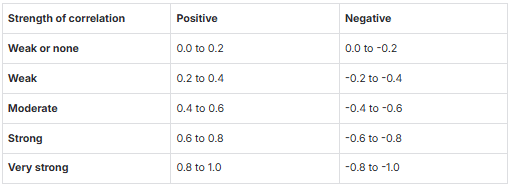
Over the entire 1987-2026 period, no significant correlation with gold can be observed for either WTI (0.13) or Brent (0.14). The price of gold and crude oil moved independently of each other.
However, in the last five years, a weak-moderate negative correlation was observed (WTI: -0.27, Brent: -0.49), meaning that the price of gold and the price of crude oil tended to move in opposite directions.
And so, looking at the weekly price movements of gold and crude oil over a longer period, it becomes clear that there is no correlation or only a very weak one.
Conclusion: gold and crude oil are two very different investments.
While gold and crude oil are naturally finite resources, as investments they aren’t really comparable, or only to a limited extent:
👉 Value density: Currently, one ounce of gold is worth between 38 and 47 barrels of crude oil.
👉 Return: The long-term return on gold has been significantly higher than that on crude oil.
👉 Risk: In the short term, the price of crude oil is subject to very strong fluctuations.
👉 Long-term correlation: There is little to no correlation between the price movements.
👉 Short-term negative correlation: While the price of gold rose, the price of crude oil fell.
At GOLD AVENUE, we sell a wide selection of gold bars and gold coins. Precious metals purchased from us can be stored free of charge in our highly secure Swiss vaults up to a deposit of €10,000.