Gold in the Movies: Hollywood Myths, Iconic Films, and the Reality Behind the Treasure
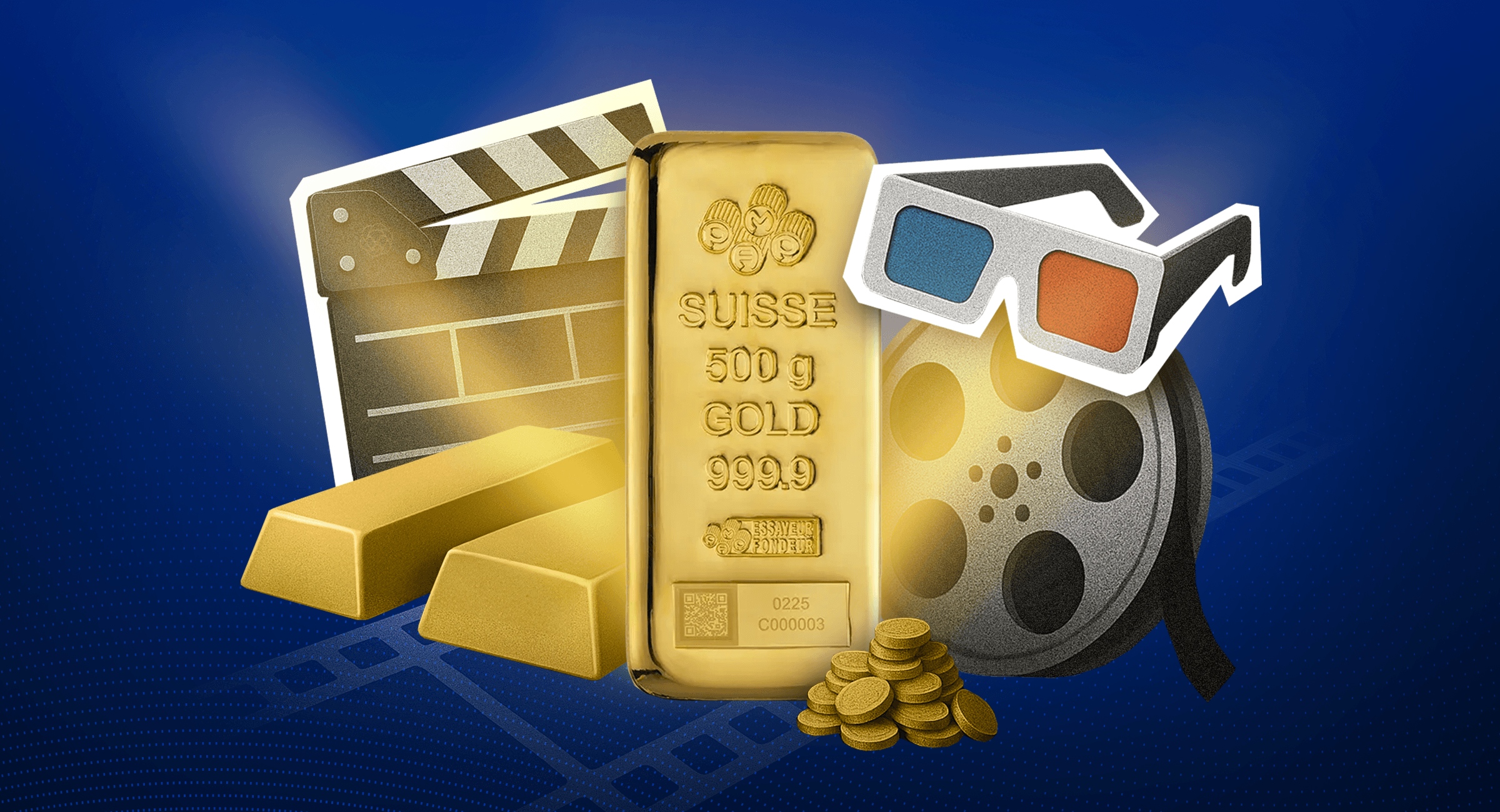
Gold has long been a powerful myth in cinema. We explore the best gold-themed films and the narratives built around the precious metal.
From glittering treasure chests to daring heists and glowing suitcases, gold has long played a starring role in cinema.
In the real world, gold is valued for its rarity, durability and role as a store of value across thousands of years. It has underpinned currencies, shaped empires and offered financial protection during periods of uncertainty.
In the movie world, however, gold becomes something else entirely.
It is amplified, romanticised and mythologised - overlaid with emotion, excitement and danger. On screen, gold rarely behaves like metal. Instead, it becomes the ultimate prize: the object worth risking everything for. From James Bond’s Goldfinger to modern heist dramas and treasure-hunting adventures, cinema has repeatedly transformed gold into something larger than life - a substance capable of corrupting, seducing and reshaping the fate of everyone who comes into contact with it.
So how is gold portrayed in movies, and why does cinema so often distort the reality of gold? What are the different narratives filmmakers use? And what are the most common myths Hollywood gets wrong, from impossible heists to weight-defying gold bars?
Why Gold Fascinates Us, On Screen and in Real Life
Gold occupies a unique place in human history. Unlike most materials, it does not corrode, tarnish or degrade. Civilisations separated by thousands of years have valued it instinctively.
That universality makes gold a powerful storytelling device.
When a character seeks gold, the audience immediately understands the stakes without explanation. Gold communicates wealth, power and permanence in a single visual cue.
Cinema takes that reality and pushes it further, transforming gold into something symbolic, emotional and often supernatural.
How Cinema Turns Gold Into Myth
In films, gold is rarely neutral.
It seduces heroes, corrupts villains and fuels obsession. It glows in the dark, fills ancient chambers and changes the fate of entire nations, all while conveniently ignoring the laws of physics.
Over time, five dominant cinematic narratives around gold have emerged.
The Five Narratives of Gold in Film
1. Mythical Gold: Treasure Beyond Reason

In this narrative, gold exists closer to legend than reality.
Iconic examples include:
- Indiana Jones and the Temple of Doom (1984) IMDb 7.5
- Pirates of the Caribbean series (2003–2017) IMDb 7.1–8.0
- The Hobbit: The Desolation of Smaug (2013) IMDb 7.8
- The Mummy (1999) IMDb 7.1
Here, gold appears in impossible quantities: glowing idols, endless piles of coins and vast chambers overflowing with treasure. In The Hobbit, Smaug swims through gold as though it were water. In Indiana Jones, sacred idols are lifted effortlessly with one hand.
Gold becomes fantasy, not finance.
Myth vs Reality: Can Treasure Really Look Like That?
Myth
Movie treasure rooms overflow with mountains of gold coins and glowing artefacts.
Reality
Gold is extremely dense. One tonne of gold fits into a cube measuring just 37 centimetres per side. The vast chambers seen in films would weigh hundreds of thousands of tonnes, enough to collapse the ground beneath them.
Gold does not shimmer in the dark. It reflects light; it does not emit it.
2. Heist Gold: The Fantasy of Portable Wealth

This is where Hollywood’s gold myths become most obvious.
Famous examples include:
- Goldfinger (1964) IMDb 7.7
- The Italian Job (1969 / 2003) IMDb 7.2 / 7.0
- Die Hard with a Vengeance (1995) IMDb 7.6
- La Casa de Papel/ Money Heist (2017) IMDb 8.2
Perhaps the most influential gold film of all is Goldfinger. Released in 1964, the James Bond classic helped cement gold’s place in cinematic mythology. With its Fort Knox setting and a villain obsessed with manipulating global gold supplies, the film portrayed bullion not merely as wealth, but as power. And like all of these films, it relies on one irresistible idea: that gold can be stolen and easily carried away.
Characters sprint with duffel bags of bullion, load vehicles without issue, and escape at speed, most memorably in The Italian Job, where Mini Coopers race through Turin carrying hundreds of gold bars.
It’s iconic cinema. It’s also impossible.
Myth vs Reality: How Heavy Is a Gold Bar?
Myth
Characters lift, throw and run with bags full of gold bars.
Reality
A standard gold bar weighs approximately 12.4–12.5 kilograms (27.4 pounds).
That means:
- 4 bars ≈ 50 kg
- 10 bars ≈ 125 kg
In real life, even trained professionals struggle to carry more than one or two bars at a time. Vehicles loaded with large quantities would suffer suspension failure, reduced braking, and mechanical damage.
Gold doesn’t clink. It thuds.
3. Historical Gold: Empire, Conquest, and Obsession

Some films take a darker, more historically grounded approach.
Notable examples include:
- Aguirre, the Wrath of God (1972) IMDb 7.8
- The Mission (1986) IMDb 7.4
- Apocalypto (2006) IMDb 7.8
These stories draw on the real history of European conquest in South America and the enduring myth of El Dorado - the belief in cities of unimaginable gold.
Historically, much of the gold encountered by conquistadors was ceremonial. It was melted down almost immediately and shipped to Europe as bars or coins.
Cinema reframes this history as obsession. Often the gold itself barely appears on screen, yet it drives every decision, betrayal, and downfall.
4. Symbolic Gold: When the Metal Becomes an Idea

Perhaps the most famous symbolic example appears in:
- Pulp Fiction (1994) IMDb 8.9
The glowing suitcase is one of cinema’s great mysteries. Its contents are never revealed, yet its value is instantly understood. Many interpretations suggest it contains gold but the brilliance lies in what we don’t see.
Had the case contained even four standard gold bars, it would weigh close to 50 kilograms, making the one-handed carrying seen in the film impossible. By never showing the contents, the film allows gold to function as an idea rather than an object: desire without physics.
Myth vs Reality: The Glowing Suitcase
Myth
Gold emits a warm, supernatural glow.
Reality
Gold reflects light; it does not glow on its own. In cinema, glow is used to communicate value instantly, not realism.
5. Gold as Romance: Adventure, Love, and Escapism

In this narrative, gold represents possibility rather than obsession.
Iconic examples include:
Fool’s Gold (2008) IMDb 5.7
Romancing the Stone (1984) IMDb 6.9
The Thomas Crown Affair (1968 / 1999) IMDb 6.9 / 6.8
Titanic (1997) IMDb 7.9
Here, gold is less about power or conquest and more about escape, second chances and emotional reward. In Fool’s Gold, the hunt for lost Spanish treasure, including gold coins, becomes a way for a fractured couple to reconnect. In Romancing the Stone, treasure hunting provides the backdrop for romance, humour, and personal transformation.
Even when the treasure itself is symbolic, as in Titanic, its value lies not in price, but in memory. Gold, gemstones and precious objects become emotional anchors rather than financial ones.
Gold becomes romance, not riches.
Myth vs Reality: Does Gold Promise Happiness?
Myth
Finding gold leads to instant fulfilment, love and a happily-ever-after ending.
Reality
Gold does not create meaning on its own. Its emotional value comes from what people attach to it - memory, commitment, legacy, and shared experience.
Which may explain why cinema so often links gold with love stories: not because it guarantees happiness, but because it endures long after the moment has passed.
Why Hollywood Keeps Getting Gold Wrong
Because realism slows storytelling.
Real gold is heavy, awkward, and difficult to move. Filmmakers prioritise pace, tension and symbolism over metallurgy. In movies, gold behaves the way emotion behaves - immediate, powerful and irresistible.
That distortion may be unrealistic, but it reveals something true: gold’s power has never been purely physical. Its influence has always been psychological.
From Movie Myth to Real-World Gold
In cinema, gold glows, curses and corrupts. It drives characters to obsession, betrayal and daring escapes - whether that’s risking everything to recover Marsellus Wallace’s mysterious suitcase, or attempting to outrun the laws of physics with a car boot full of bullion.
In real life, gold’s role is quieter but no less enduring. For thousands of years, it has preserved value, survived the rise and fall of empires, and continued to play a role in portfolio diversification through periods of inflation, crisis and uncertainty. Its price continues to be shaped by global markets.
The good news is that you don’t need to plan a heist, infiltrate a vault, or test the suspension on your getaway vehicle to own gold today. It’s far easier, and considerably safer, to buy physical gold online and have it securely stored for you in professional vaults.
Because while Hollywood may love turning gold into myth, the real power of gold has never been about spectacle.
It’s about time.