What is the gold to silver ratio?
You might see it written as the gold:silver ratio, gold-silver ratio or the gold/silver ratio. Either way, it’s the same thing. It’s essentially a quick sum that calculates how much silver you’d need to buy one gram (or ounce, or kg) of gold at the spot price. In effect, showing their relative values.
Calculators at the ready
Let’s take today’s gold to silver ratio (28 April 2026). According to our live price chart, gold is currently trading at £110.44 per gram. If we jump to our live silver price, that’s at £1.77 per gram.
Calculators at the ready:
110.44 ÷ 1.77 = 62.4
The gold-silver ratio today is 62.4.
Why does the gold to silver ratio matter to investors?
Of course when it comes to buying gold or silver, the spot/live price might be your first port of call. But that only shows part of the picture.
By checking the gold to silver ratio, you can see the relative popularity of one metal compared to the other. This makes it a valuable tool for investors:
- When the ratio is high, it means that the price of silver is undervalued compared to the price of gold. In other words, it may be a good time to buy silver and sell gold.
- When the ratio is low, the opposite is true. Investors may want to consider buying gold and selling silver instead.
What factors affect the gold to silver ratio?
Supply and demand
This is the most basic driver of prices across all sorts of products. In the case of precious metals, it might look a bit like this:
- Investors start to buy silver, believing it’s currently undervalued, so…
- The demand for silver grows.
- Increased demand drives up the price of silver, resulting in…
- A lower gold to silver ratio (it will take fewer grams of silver to buy one gram of gold).
Global economy and geopolitics
In uncertain times, many investors turn to precious metals as ‘safe-haven’ assets. They’re seen as a reliable store of value to protect wealth.
If the global demand for gold (the ultimate safe-haven asset) increases, while silver is neglected, the gold to silver ratio will go up. As happened during the Covid pandemic.
Silver-hungry tech
With the rise of the electronics industry over the last century or so, silver has seen a huge growth in demand.
In 2020, this sector represented approximately 9% of the global demand for silver, according to the Silver Institute. The result? A decline in the gold to silver ratio.
Tracking historical prices and the gold to silver ratio
The gold-to-silver ratio typically ranges between 40 and 80. It's when the values fluctuate towards these extremes that investors usually make the decision to buy or sell.
First, let’s look at their prices in isolation.
Gold to silver ratio: live prices and historical trends
In times of economic uncertainty, many investors turn to physical assets like gold and silver. But which should you buy, and when? Whether you’re researching your first foray into precious metals, or a seasoned investor looking to maximise your return, the gold to silver ratio is always one to watch.
The historical price of gold
Last update: Sep 23, 2026, 10:00 PM
| 1 month | 6 months | 1 year | 5 years | 10 years | 20 years | 50 years |
|---|---|---|---|---|---|---|
-4.63% | -3.28% | +18.82% | +148.99% | +222.34% | +676.16% | +3865.38% |
The historical price of silver
Last update: Sep 23, 2026, 10:00 PM
| 1 month | 6 months | 1 year | 5 years | 10 years | 20 years | 50 years |
|---|---|---|---|---|---|---|
-4.33% | -4.65% | +53.31% | +193.33% | +241.72% | +474.57% | +1424.53% |
Historical trends in the gold to silver ratio
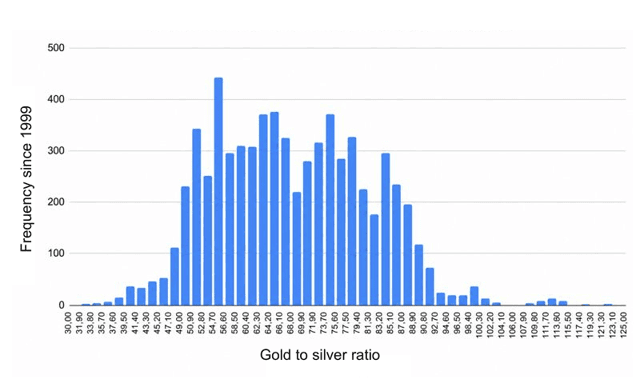
The chart above shows the distribution of the frequency of the gold to silver ratio since April 1999.
The historical average of the gold to silver ratio is 68, but the most frequent value is between 55 and 57.
Approximately 20% of the observations are above 80, which is generally considered a high ratio.
- Average gold to silver ratio: 68
- Maximum value (March 17, 2020): 124
- Minimum value (April 28, 2011): 32
- Historically high ratio: 80 or more (silver is cheap)
- Historically low ratio: 40 or less (gold is cheap)